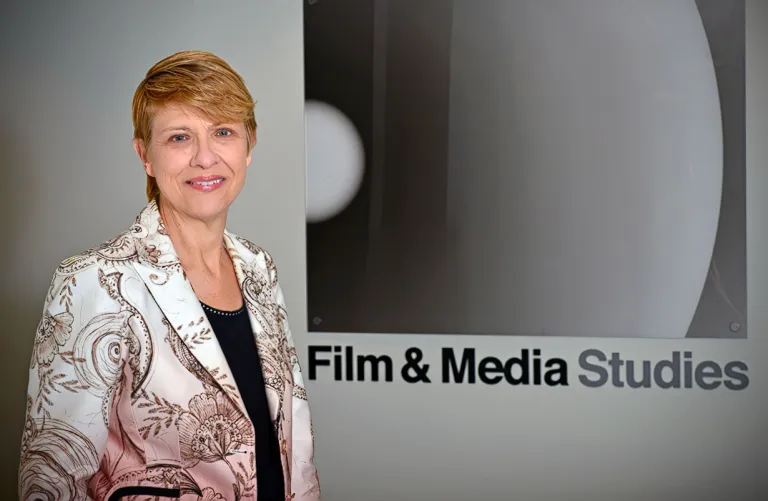
FMS is saddened to announce the passing of Gaylyn Studlar, David May Distinguished University Professor Emerita in the Humanities and former director of the Film & Media Studies (FMS) program. She died on September 9, 2026, at the age of 73.
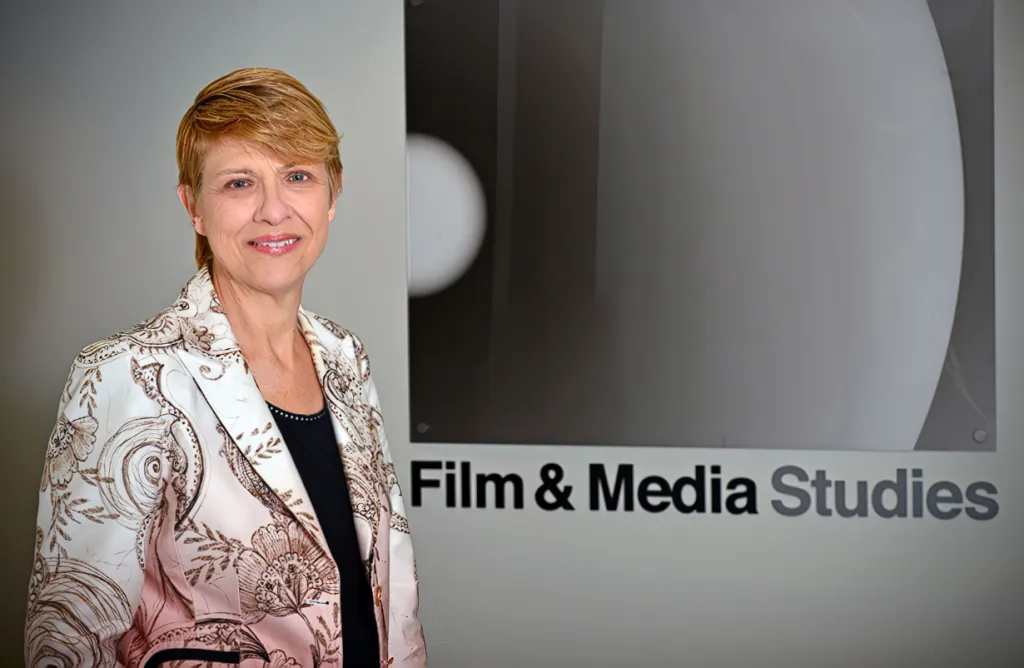
Studlar was recruited to WashU in 2009 to oversee the expansion of FMS, a distinct, standalone program founded in 1998 within the College of Arts & Sciences (A&S).
During her time as program director (2009-2021), Studlar transformed FMS’s infrastructure, faculty, and curriculum. She secured an A&S investment of $1.6 million to build FMS’s office suite in Seigle Hall and negotiated $180,000 in upgrades to FMS’s premium screening facility, Brown Hall 100.
Simultaneously, she grew FMS’s faculty with six tenured-track positions, three as full appointments in FMS and three in partnership with the departments of African and African American Studies, East Asian Languages and Cultures, and Women, Gender, and Sexuality Studies.
In 2013, she spearheaded the creation of FMS’s master’s degree, a program of study that has graduated dozens of students who have gone on to careers in public relations, videogame design, and education, and pursued doctoral studies at UCLA and UW-Madison. At the undergraduate level, she designed FMS’s Production Concentration major, launched in 2019.
Her leadership laid the groundwork for FMS’s growth in the areas of digital media, video games, and AI. Her 2017 vision plan became the unit’s blueprint, yielding hires in Black digital media studies, Chinese digital media studies, and videogame studies and design. Continuing on this path, FMS’s curriculum redesign in 2026-2027 will launch new courses in Introduction to Digital Media Studies, History of Computing, Media Theory, AI: An Introduction to Critical Technology Studies, AI Video Game Design, and Screenwriting with AI.
These farsighted successes at WashU added to a distinguished career in leadership in which she oversaw the development of film and media units at University of Michigan and Emory University, currently two of the top departments in the field.
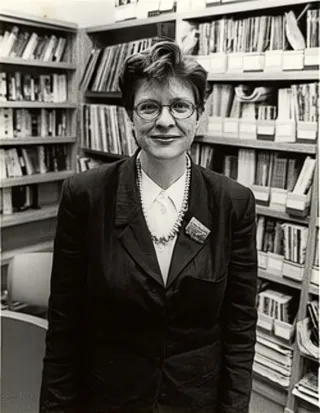
At Michigan, where she served as program director and then department chair from 1995 through 2008, she was instrumental in launching the unit’s successful Screenwriting Program in 1995 and in achieving department status for the unit in 2005.
She helped enlarge film and media’s scope at Michigan through a philosophy of interdisciplinarity. She stated at the time: “We’re hoping to expand the program’s profile in working with other departments and schools within the University to cross-fertilize both the creative and intellectual aspects of studying film and video.”
Across her various university appointments, Studlar’s vision for interdisciplinarity remained inclusive and principled. It was shaped by the conviction that film studies and media studies should strive to establish themselves as distinct disciplines that stood tall among their peers in the humanities. No area of study can experience the fruits of interdisciplinarity if its disciplinary status is questioned.
As the tributes below attest, Studlar was committed to rigorous film and media pedagogy and research centered on a comprehensive approach that combines film history, film theory, and film analysis. This also includes film production as a salient aspect of liberal education. As she stated during her appointment at the University of Michigan, “We’re not training students to shoot them into the film industry. We’re educating them for life. We’re training their minds.”
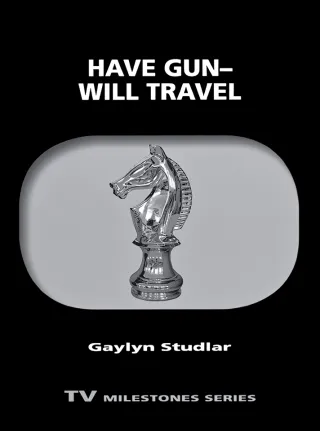
Alongside her leadership, Studlar built an accomplished career as one of the most influential feminist scholars of her generation. Her impressive publication record includes four monographs, four co-edited volumes, and some fifty articles and chapters, on topics ranging from masochistic aesthetics, Orientalism, masculinity, and girlhood in cinema, to Titanic (1997), TV westerns, the stardoms of Elizabeth Taylor, Mary Pickford, and Clara Bow, and Rambo movies. Committed to public scholarship, she also completed over ten DVD commentaries, including one on The Earrings of Madame de… (1953), currently available on the Criterion Channel.
While completing her degree in Communication (Cinema) at USC, Studlar published her most influential work, the article “Masochism and the Perverse Pleasures of Cinema” (1983). She revised the piece as “Visual Pleasure and the Masochistic Aesthetic” (1985), her preferred articulation of the argument, available here.
Once described to her as “dangerous” work for its pointed critique of Laura Mulvey’s “Visual Pleasure and Narrative Cinema” (1975), her research on masochism presents a forward-looking view of film pleasure which emphasizes a fluid identification with other genders, sexualities, and forms of desire. The original “Perverse Pleasures of Cinema” article soon became a staple of humanities curricula across North America and the globe, remaining continually in print and standing alongside Mulvey’s essay and Mary Ann Doane’s “Film and the Masquerade: Theorizing the Female Spectator” (1982) in a rich and evolving tradition of feminist theory whose implications reach far beyond the study of film.
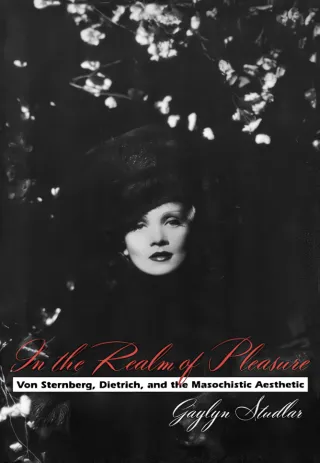
Studlar’s early articles laid the foundation for her widely cited first monograph, In the Realm of Pleasure: Von Sternberg, Dietrich, and the Masochistic Aesthetic (1988, revised 1992). The book is a theoretical one aiming “to redress feminist theory’s current neglect of sexually undifferentiated aspects of film reception” (p. 3)
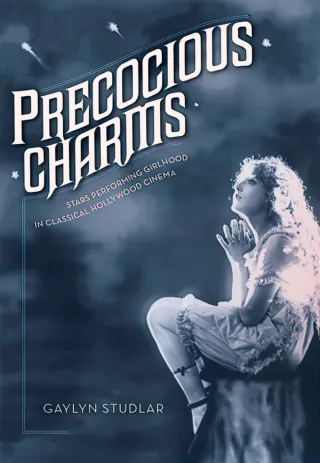
At WashU she continued her groundbreaking scholarship, increasingly focused on what she termed the “the historically specific ‘spade work’” that was “necessary as the foundation for theoretical generalizations in film studies” (from 1996’s This Mad Masquerade, p. 6). Fine-grained archival studies of gender in Hollywood followed, including Precocious Charms: Stars Performing Girlhood in Classical Hollywood Cinema (2013). It investigated “through an approach that is simultaneously analytical, historical, and theoretical, how embodiment by movie stars is incorporated into film to elicit fascination with girls and girlhood through femininity aligned with juvenated qualities, whether physical or psychological” (p. 7).
In recent years, she remained committed to historical research and was preparing a new monograph. Tentatively titled “Erotic Labor: Sex, Class, and Stardom in Pre-Code Hollywood, 1924-1934,” the study, as Studlar described it, would address “Hollywood’s representation of female star bodies and sexuality in relation to class before PCA was instituted.” She delivered a sample of that work in her final public lecture on April 17, 2025, entitled “Women’s Erotic Labor and the Negotiation of Class Identity in ‘Pre-Code’ Hollywood Stardom, 1924-1934,” part of the 2025-2026 FMS Colloquium Lecture Series.
At the time of her passing, Studlar was also at work on a book devoted to landscape and conquest in Hollywood westerns, tentative title “Westward Ho: Hollywood and Sentimental Manifest Destiny.”
FMS will honor her commitment to excellence in scholarship with an Annual Gaylyn Studlar Lecture, a series spotlighting cutting-edge work in feminist film and media studies.
The inaugural Gaylyn Studlar Lecture will be delivered by Samantha Noelle Sheppard of Cornell University on October 8, 2026, in this year’s FMS Colloquium Lecture Series.
❧
In celebration of Studlar’s legacy, FMS has collected tributes from colleagues at WashU, the University of Michigan, and Emory University, as well as mentees from across the field. FMS is heartened by the response, a testament to Studlar’s lasting impact on the academy, cinephilia, and the life of the mind.
When I joined the Film Program at Emory University in 1989, I knew Gaylyn was a formidable intellect. She also seemed to me to be a formidable person. As we became friends, I realized she was one of a kind, truly unique. She was compassionate and also completely honest, authentic and direct—a real straight shooter, in a setting full of people who specialize in not saying what they really think. She had an immensely important impact on me through her scholarship which was incisive, meticulous and field-changing. Collaborating with her on two anthologies was exciting and a sheer joy. She was a generous mentor. It was a huge loss to Emory when she left. She also had a true gift for program building, which she took to new heights at the University of Michigan and Washington University. I am glad we can continue to learn from her through her inspiring and insightful work.
—Matthew Bernstein, Goodrich C. White Professor Emeritus, Department of Film & Media, Emory University
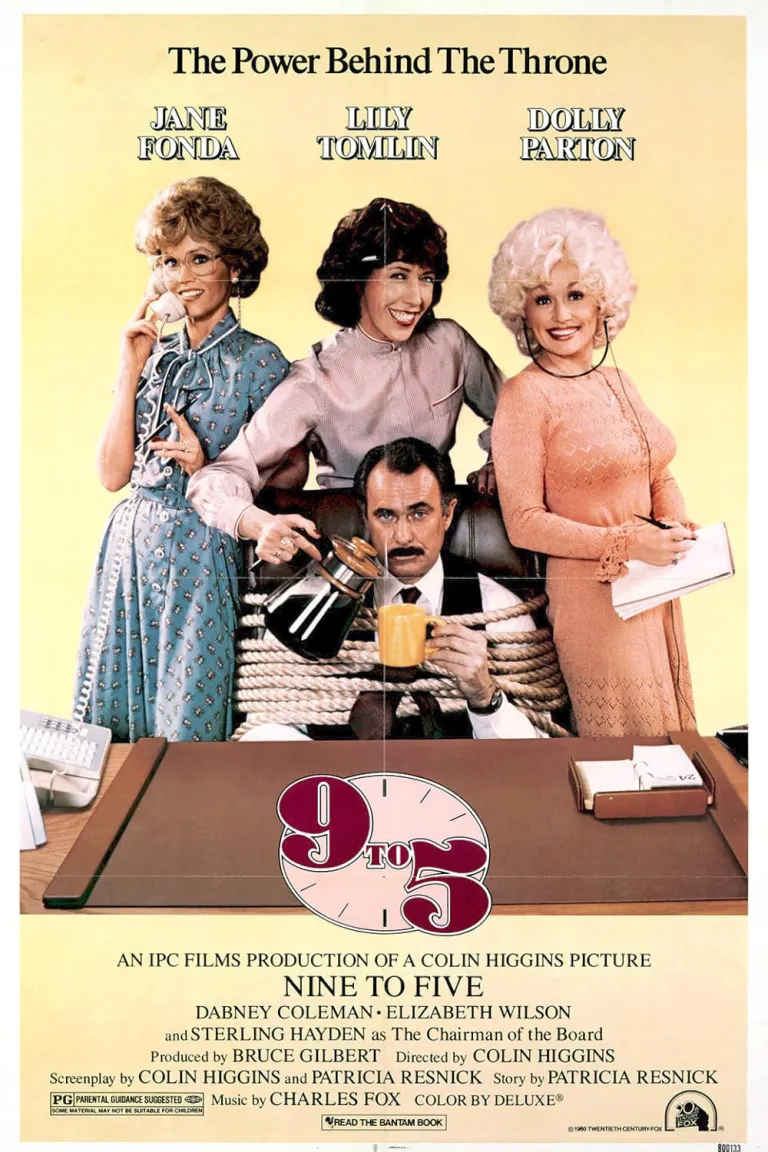
Gaylyn joined the University of Michigan’s Program in Film & Video Studies in Fall 1995, the same year I started teaching screenwriting at my alma mater. We immediately hit it off because she reminded me so much of the powerful women I worked for in Hollywood, producer Sara Colleton and director Penny Marshall. One day that very first year she summoned me to her office and told me to take out a blank sheet of paper and write down the three things I needed to build a Screenwriting Program. Her vision was to build the Film & Video program into a full-fledged department by building around the University of Michigan’s long history of educating dramatic writers... from Arthur Miller to Lawrence Kasdan. I told her the three things I needed: a full semester rewrite class (who knew there was no such thing at any other school at the time?); a screenplay library; and a Visiting Artists Program. I knew plenty of people who would be willing to come to Ann Arbor to speak to our students if we could afford to bring them here. Gaylyn thought these were all great ideas. And then she said with a smile: “You know Hollywood. Now we’re going to send you there to raise the money from Michigan alums in the industry.” There was something in her voice that was so calm, certain, and amused that I, too, thought this was a swell idea. Gaylyn was a true visionary—the type of leader who can convince you to do things that you never even thought of doing. There are so many of our students working in Hollywood today who have fulfilled dreams they never would have had but for Gaylyn’s vision. She was a great leader who could move heaven and earth when she needed to. I am forever grateful to Gaylyn for the time she got Michigan’s College of Literature, Science, and the Arts to grant Yao Phillips, my student in the very first rewrite class who died suddenly early in the semester, his degree posthumously. Gaylyn and I were both invited to speak at Yao's very large funeral in Evanston, Illinois. When Gaylyn announced that Yao was officially a college graduate, the outpouring of joy was beyond anything I have ever seen at any graduation.
Gaylyn was a brilliant scholar and teacher and above all a true friend. May her memory be a blessing.
—Jim Burnstein, John H. Mitchell Professor of Entertainment, Department of Film, Television, and Media, University of Michigan
I owe Gaylyn the most enduring part of my professional life. I am not just talking about the exhilarating career starts, which sadly one gets used to. I am talking about the gift of knowing that a severe, in-your-face but always generous mentoring bears the best and longest-lasting fruits for all parties involved. We shared a love for the study of Valentino, but she is the one who built the place where one could make a career out of studying the 1920s. And then she went elsewhere to perform, I gather, pretty much the same miracle. She will always be my diva.
—Giorgio Bertellini, Professor, Department of Film, Television, and Media, University of Michigan
Reflecting on the many roles that Gaylyn took on at WashU, one can only be grateful for her sharp intellect, her savvy insights about university life, her lively engagement with her students, her unwavering commitment to mentoring early career faculty, her passionate support of the FMS unit, and her desire to build meaningful connections across the humanistic disciplines. One didn’t always agree with her, but most often a good laugh or a good story came out of any encounter. For me, a great highlight of my teaching in the last decade was the chance to co-teach a seminar on Orientalism in film and visual art. We immersed the class not only in museum collections in St Louis, but also in a veritable whirlwind of films featuring a range of Hollywood sheiks, sprawling casbahs, towering pyramids, dying Cleopatras and risen mummies, as well as investigations of key theoretical concepts from Edward Said forward. That seminar launched some long-standing passions for more than one art history graduate student, and it is a great pleasure to revisit our shared thinking that went into that joint adventure. As a dear friend, a deeply respected colleague, and a campus leader devoted to the Humanities, she will be deeply missed for these reasons and more.
—Elizabeth Childs, Etta and Mark Steinberg Professor of Art History, Department of Art History and Archaeology, WashU
I knew Gaylyn as a scholar before she became my colleague, mentor, and friend. After reading her book This Mad Masquerade: Stardom and Masculinity in the Jazz Age as a grad student, my first thought was “This is the kind of scholar I want to be.” Her books are deeply researched, beautifully written, and always deliver news—whether in the historical details she dug out of the archives, in close readings of familiar and unfamiliar films, or in theoretical ways of seeing that tacitly called out whole swathes of conventional academic wisdom. In person, I discovered Gaylyn had a rare gift for supportive listening: she'd hear my department chair woes and offer vigorous encouragement. I left many a lunch with her feeling newly enthusiastic about my work. Gaylyn loved classical music. She had a Master’s in cello performance from USC and was a faithful concertgoer. I could always find her near her seat on the aisle during intermission at the WashU Great Artists Series. I will especially miss knowing that Gaylyn is in the audience and hearing what she thought of the music we heard together.
—Todd Decker, Voting Affiliate in Film & Media Studies, Paul Tietjens Professor of Music, Department of Music, WashU
It is with great sadness and shock that I learned of Gaylyn’s passing. I started at Michigan in 1996, just one year after she did, and I had already become an admirer of her work because of This Mad Masquerade, one of her many great books which I wrote to her about. We quickly became good colleagues and friends when I got to UM. She was the Director of the program in film and video and when I became chair of Communication Studies in 2004, we worked together often as we were each trying to build up our units. Gaylyn was ambitious in all the best ways and was determined to build the program up into a full-fledged department, which she did. She insisted on scholarly rigor in hiring and promotion and did not suffer fools. (I think she once told me, wryly, that in her teaching, she wouldn’t smile until the end of the semester, as a way to keep the students on their toes.) I especially admired her fierce defense of film studies against the poaching efforts of other units thinking they, too, could offer courses in film history and theory without the training that Gaylyn and her colleagues had. She had a great wit, dry sense of humor, and a great laugh. I have to confess that she and I did enjoy, often over a drink, sharing our sometimes uncharitable assessments of stupid institutional practices or obviously incompetent people we saw bungling along. Because of her high standards, work ethic, and, again, terrific sense of humor, she was so great to work with. I really missed her when she went to WashU, and we did stay in intermittent touch, so I am now treasuring those emails. This is a great loss; what a great scholar, leader, and presence she was.
—Susan Douglas, Catherine Neafie Kellogg Professor and Arthur F. Thurnau Professor, Department of Communication and Media, University of Michigan
Over a quarter of a century ago, when I was hired in Film & Video Studies at University of Michigan, Gaylyn Studlar was our director. Gaylyn could be challenging. She had high standards for others and for herself—and the resulting atmosphere was not always frictionless. Nevertheless, when I needed someone to champion my tenure case, Gaylyn was there, and I am eternally grateful for her belief in me and her support.
—Bambi Haggins, Associate Professor, Film & Media Studies, University of California, Irvine
Gaylyn Studlar was a formidable force. I’m grateful for the way her influence has been carved so deeply into the identity of the Film & Media Studies program at WashU. Because of Gaylyn, everyone in our program, no matter our various research interests, is invested in a version of film and media studies with historical rigor and feminist commitments. Gaylyn’s work and life were a model of this, and she built a program where these values are sustained.
After she retired, Gaylyn continued to attend our monthly colloquia. I think this is because she was so invested, not just in hearing the new research being presented, but also in making sure that FMS was on the right track and maintaining the commitments that she had helped establish. On a more personal note, those days were a special treat because it meant hearing her distinctive voice in our office hall. I’d immediately drop what I was doing to run out and find her in her red trench or one of her other fabulous coats (Gaylyn had a sharp sense of style!). I treasured these opportunities to catch up with her and see how she was always energized and animated by the research and films she was working on—most recently she was telling me about Christmas movies she was researching and how surprisingly dark they were. And she was so funny! Gaylyn was FMS’s great wit! I will miss her so much, but with my colleagues I hope to help maintain her memory and influence on the field because it will be better for it.
—Reem Hilu, Associate Professor, Film & Media Studies, WashU
Nearly as strong as her passion for film studies was Gaylyn’s devotion to program building—and community building. Everyone who loves film was welcome to join her community, regardless of their level of expertise or discipline. (And we were all invited to her house, too.)
—Robert Hegel, Liselotte Dieckmann Professor Emeritus of Comparative Literature, Department of East Asian Languages and Cultures, WashU
Gaylyn's scholarship will continue to influence as a model of theoretically informed historical inquiry. Her research on celebrity and fandom in classical Hollywood cinema was deeply rooted in extensive knowledge of the period's magazines and newspapers, industry practices, and archival materials, including legal contracts and marketing materials. At the same time, she was guided by the conviction that “A man with only one theory is a lost man.” This quote from Bertolt Brecht appeared on her syllabus for Film Theory, which I inherited from her in 2013 when I began my position at WashU. I still have Gaylyn’s description of the course and her reading list, which was sent to me the day after I accepted the job offer. The syllabus reflects her deep commitment to a liberal arts education, as well as her intimidating rigor. One of the goals of Film Theory, she writes, is “to contribute to a liberal arts education as a process in which intellectual growth and engagement with ideas are ‘liberating’ in the sense of opening the mind to ideas.” Given the difficulty of the material, she directs that “all reading should be done by the first class of the week and REREAD [her emphasis] for Wednesday,” the next class meeting. Gaylyn organized her Film Theory course roughly chronologically, and returning to the syllabus today, I am especially struck by how silent cinema was given no short shrift. The first five weeks of the class were dedicated to cinema of the 1910s and 1920s. In addition, by the number of films—early films were short—silent films represented well over half of the total number of titles shown. That said, in true form, Gaylyn took Film Theory right up to the present when she stopped teaching the class in the early 2010s, ending with Avatar (2009) and emerging digital technologies. The course was very dear to Gaylyn, and I will always be grateful that she entrusted it to me for roughly a decade, allowing me to make it my own. It was also, fittingly, one of the final classes that she taught at WashU. She returned to the helm of Film Theory for the last two years before she retired. Gaylyn's dedication to theory-driven teaching and research has indelibly shaped Film and Media Studies at WashU. At her insistence, the program encompasses visual analysis, history, theory, and practice—across global cultures and diverse media technologies—spanning not only commercial entertainment but also boundary-breaking new forms.
—Diane Lewis, Associate Professor, Film & Media Studies, WashU
I was Gaylyn’s first tenure track hire after she was lured to University of Michigan to build a film school. I felt I already knew her because we shared an inspiring mentor in Marsha Kinder. When I finally met her, I quickly discovered that we shared the same USC/MK DNA. I also found she was a force of nature, with endless energy for working the university system. She was a fierce advocate for a liberal arts approach to film studies, adding television studies to the mix, followed by digital media. Looking back, the speedy growth of our little program to a world class film and media department was extraordinary. And everyone agrees it was thanks to Gaylyn’s boundless love for the moving image and her dedication to imparting that love and knowledge to the next generation of scholars and makers.
—Markus Nornes, Professor, Department of East Asian Languages and Cultures, University of Michigan
Every time I conduct research, teach a class, or attend a meeting, I draw on something I learned from Gaylyn Studlar. In her scholarship, Gaylyn demonstrated that it was possible to be a prodigious film theorist, analyst, and historian. In her mentorship of students, she was compassionate and demanding. And perhaps above all, she thrived on advocating for Film and Media Studies at WashU, calling the shots with insight, toughness, and West Texas charm. I marvel at my own good fortune to have learned how to be a professor from Gaylyn Studlar.
—John Powers, Associate Professor, Film & Media Studies, WashU
It’s difficult to enumerate all the ways that Gaylyn had an impact on my career and trajectory. Gaylyn had an undeniable impact on the field and on my own way of thinking about history. She had a rigorous approach to the life of the mind and to every intellectual endeavor. In her classroom, I found the first compelling challenge to really think deeply about film in my intellectual life, and this was due to the thoroughness and depth of her classroom style and her approach to thinking about film. To Gaylyn, in studying film you were not just studying a mode of entertainment but a powerful space of projection for the mind writ large. In her class, I first begin, thinking about spectatorship and the psychology of the cinema. Her work challenged me—as it still challenges all of us to think about pleasure, desire and sexuality in expansive ways that to my mind still represent the cutting edge of the field. In “Gunsel is Being Beaten: Gangster Masculinity and the Homoerotics of the Crime Film,” “Oh, ‘Doll Divine:’ Mary Pickford, Masquerade, and the Pedophilic Gaze,” and of course In the Realm of Pleasure: Von Sternberg, Dietrich, and the Masochist Aesthetic, which challenged any easy (and heteropatriarchal) Freudianism, reminded us of the Pre-Oedipal stage in which the breast was everything, and considered aesthetics as blended with spectatorial concerns, she enjoins us to think about sexual desire in ways defy normative expectations about intimacy and its haunts. She had a talent for stripping away the conventions of the day and getting to the heart of what was really happening behind the cinematic curtain, a talent that deeply shaped me as an historian of censorship. Though she’s most often thought of as someone who intervened in feminist film theory, which, of course she did, her contributions to thinking through sexuality and the cinema—as well as film history and historiography—are underheralded. As a film historian, her work on masculinity and particularly Valentino and Fairbanks modeled an integration of history and theory that challenged patriarchal constructions of manhood through precise exploration of various eras’ constructions of masculinity.
On a personal note, her dedication to me as a student was ardent and expressed through the giving of significant attention and time to my work. I will always remember the fundamentals she taught as I sought for my own writerly voice—in particular her advice, which I use with my graduate students now, to find compelling models for writing not just scholarship. I remember the way she expressed her excitement at my work on Island in the Sun by searching online and buying me the pressbook, one filled with images of Harry Belafonte! This was the first pressbook I ever owned—and the first time I realized that professors used eBay. I still treasure it. Gaylyn was also a wonderful thinker about censorship and her approaches particularly to teaching the Production Code have had a significant impact on my teaching. I have and I always will carry with me her example, and a sense of being formed from the power of her rigor, irony, and humor. She will be deeply missed.
—Ellen Scott, Associate Professor, The Department of Film, Television and Digital Media, UCLA
Though I hadn’t been in touch with Gaylyn in recent years, the working relationship I had with her during my years as an assistant professor and up through tenure were formative, not least thanks to her mentorship and example. I learned more from her about administration, governance, and program building than I could recall. But to this day, I remember Gaylyn grilling me over brunch at the campus visit to ascertain my film bona fides. This was part of her approach to building what was then the “Program in Film and Video” into the formidable department she bequeathed us when she relinquished her collegiate professorship (named after Rudolf Arnheim, who at the time was still living in Ann Arbor) and took her talents and energy to WashU. Gaylyn insisted that the program building she envisioned required disciplinary expertise of a kind that, to her mind, was not yet recognized and established clearly enough at the time. She would brook no dilettantism, no dabbling in film by job candidates (or even established professors in other departments on campus!) trained in literature. So there I was, ABD and trained in literature, shaking in my boots while trying to make scholarly conversation over eggs and toast. The rest is history. Somehow, I must have been able to convince Gaylyn that I’d accumulated enough experience teaching film and researching my dissertation on the New German Cinema in film archives. Here I am, thirty years later, feeling time acutely, achingly with her passing, still hoping to live up to her standards. When it was my turn to pick a name for my professorship, I slipped on the title she’d left, very much conscious of the fact that in some real sense, the Rudolf Arnheim professorship now bears her name and imprint, too. Here’s looking forward to seeing one of my colleagues being appointed the Gaylyn Studlar Professor of Film, TV & Media for her to be remembered even as she is missed.
—Johannes von Moltke, Rudolf Arnheim Collegiate Professor, Department of Germanic Languages and Literatures and Department of Film, Television, and Media, University of Michigan
I first encountered Gaylyn’s research as an undergraduate student while working as an editorial assistant for the journal Film Criticism. A special issue on Feminist Film Criticism had been published just before I began at the journal, which featured Gaylyn’s article on Valentino’s stardom. Gaylyn’s essay was my introduction to scholarship on silent cinema and feminist film theory and I was captivated. Gaylyn’s article modeled the perfect synthesis of film analysis with archival research and rigorous theorization. I was delighted when, ten years later, I was hired by Gaylyn to teach in what was then the Film & Video Studies program at the University of Michigan, Ann Arbor. By then I had already absorbed This Mad Masquerade (which I taught for many years in my graduate and undergraduate film history courses at University of Michigan and UC Berkeley), and Gaylyn’s scholarship continued to shape my research on silent American cinema. When I first arrived at Michigan, Gaylyn was so welcoming, and I will never forget the fabulous dinner parties she and Tommy hosted at their lovely home in Dexter. I learned so much from her style of leadership when she was the program director. She embodied an unusual combination of remarkable administrative competence with scholarly excellence, and she carried out both with brilliance and a great sense of humor. She created such a wonderfully collegial community amongst faculty in the program. I have fond memories of standing in the hallway and having long and spirited discussions with Gaylyn on whatever we were watching or teaching at the time—The Man Who Shot Liberty Valance, The Sopranos, Blonde Venus, etc.—and it was during one of our discussions about Titanic that I pitched to her my argument on digital visual effects and the new verticality. Her response—a straightforward, “I like it. You have to write this”—gave me the confidence to embark on a new project that would take my scholarship to the other end of the twentieth century. I was only at Michigan for three years, but Gaylyn had an outsized influence on my thinking and career. I wish we had had more time together as colleagues and feel lucky to have been an assistant professor learning the ropes from someone as brilliant as Gaylyn. She has shaped our field in so many ways, and her scholarship will continue to influence film and television studies for generations.
—Kristen Whissel, Professor, Department of Film & Media, University of California, Berkeley